Compare
Payload CMS vs Sanity
The self-hosted framework model vs the managed Content Lake platform. A technical comparison for Next.js teams evaluating CMS architecture.
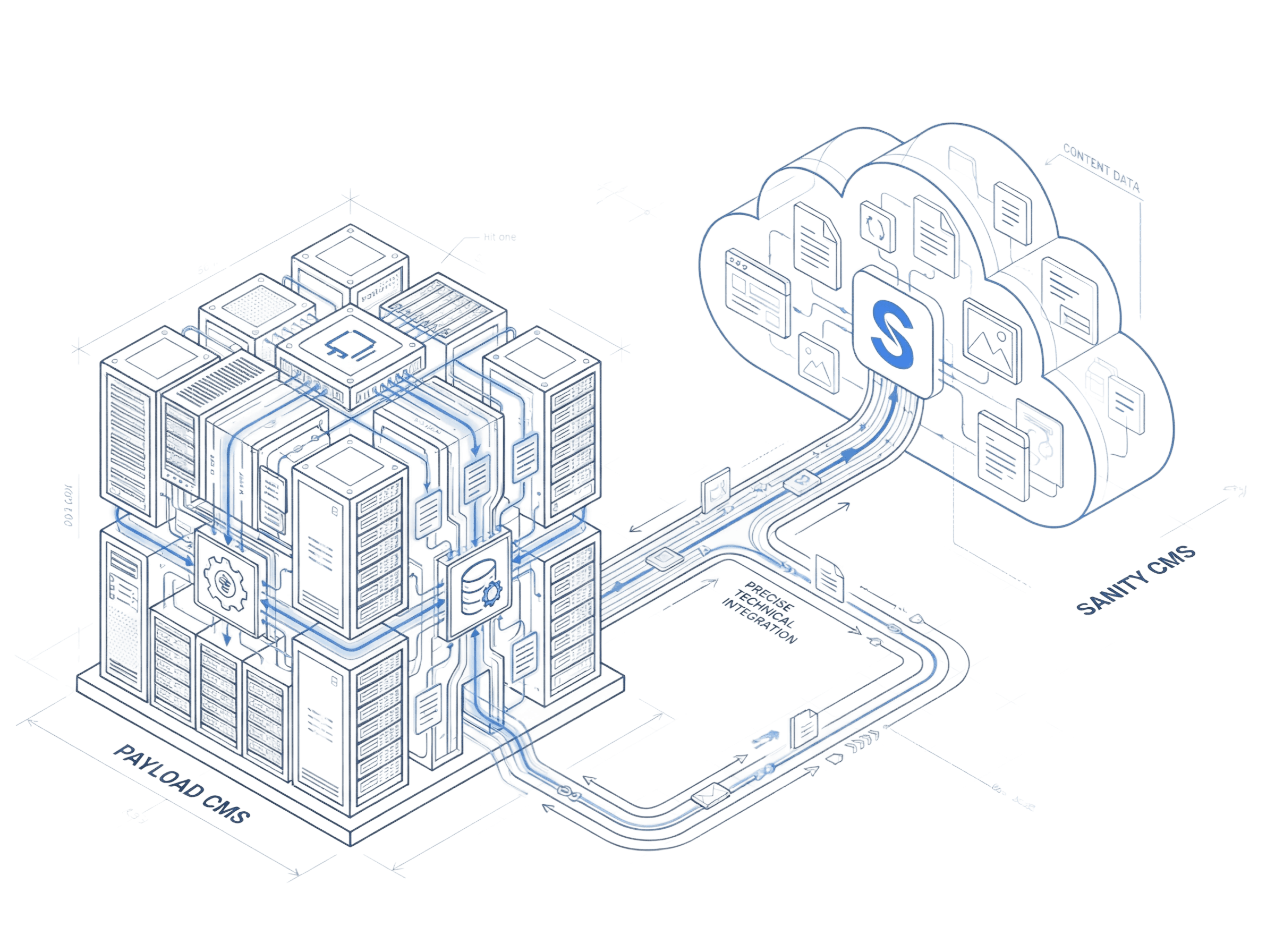
Quick Verdict
This is for you if
- You want a managed backend (Content Lake + Live CDN) with minimal infrastructure to operate.
- You value visual editing and live preview as first-class developer-experience features.
- You want powerful, rate-limited real-time query capabilities (GROQ) optimized for a hosted backend.
Not a fit if
- You must self-host or run in your own cloud/VPC for compliance, data residency, or cost control.
- You want deep integration with Next.js and local access to data from server components for maximum performance.
- You need a code-centric, extensible admin with your own DB (Mongo, Postgres, SQLite) and direct access to migrations.
| Feature Dimension | Payload CMS | Sanity |
|---|---|---|
| Architecture & Hosting | Self-hosted Node.js framework (MIT licensed) | Proprietary SaaS (Content Lake) + hosted/self-hosted Studio |
| Data Storage & Lock-in | Your own database (Postgres, Mongo, SQLite) | Proprietary Sanity Content Lake |
| API & Querying | Local API, REST, GraphQL | GROQ (optimized for Content Lake), optional GraphQL |
| Editor UX & Workflow | Heavy customization, Lexical rich text, versions limit | Highly polished, Presentation tool (visual editing), scheduled drafts |
| Multi-tenancy | Explicit multi-tenant plugin and patterns | Multi-project/dataset architecture |
| Pricing Model | Open-source core is free; pay for your infrastructure | Per-seat pricing+usage meters (Growth/Enterprise tiers) |
| Operational Risk | High: You own DevOps, scaling, and critical security patches | Low: Sanity manages infrastructure and APIs |
Where Payload wins
Complete Database Ownership and Locality
Payload is a Next.js framework that connects directly to your own database (MongoDB, Postgres, or SQLite). There is no proprietary data layer or vendor lock-in. By using the Local API, server-rendering in Next.js bypasses external HTTP calls entirely—bringing latency to absolute minimums for high-scale applications.
Uncapped Extensibility Without Seat Taxes
Because the core is MIT-licensed, scaling up editors or API requests doesn't trigger unexpected billing tiers or seat licensing fees. You dictate your limits based on your own infrastructure limits, not arbitrary platform quotas. For the full breakdown of where and how to host Payload, see the hosting guide.
True Multi-Tenant Architecture
For teams building B2B tooling or platforms, Payload allows deep multi-tenant isolation through official plugins and explicit database-level architectures. It's built for complex access control.
(Note: Ensure strict security practices, as Payload requires you to aggressively manage DB vulnerabilities and patching, such as recent Drizzle adapter updates).
Where Sanity wins
Zero-Ops Backend Architecture
Sanity fundamentally removes the burden of managing infrastructure. The Content Lake, Live CDN, and Media Library are entirely hosted. If your team cannot confidently manage database migrations, backups, and security patches (which Payload requires), Sanity is safer.
First-Class Visual Editing
Sanity's Presentation tool enables robust live preview, click-to-edit, and complex page-building out of the box. The editorial workflow includes features like Content Releases, scheduled drafts, and tasks on higher tiers, which require custom work in Payload.
Powerful Shaped Querying with GROQ
Sanity exposes data via GROQ—a specialized query language designed specifically for the Content Lake. It dramatically simplifies complex joins and projections at the API layer, allowing front-end teams to fetch exactly what they need without heavy server-side processing.
Migration considerations
Migrating to Payload:
Payload uses explicit DB migrations (with up/down functions). You construct the schema via TypeScript config, giving you total control. However, migrating means assuming the DevOps burden.
Migrating to Sanity:
Sanity manages the data separately from your Studio code. Upgrades across major versions (e.g., from v2 to v3, or v3 to v4) primarily require refactoring the Studio codebase configuration, tooling (Webpack to Vite), and plugin compatibility, while the underlying Content Lake remains untouched data-wise.
Decision Framework
The Final System Check
If total cost of ownership is part of the decision, see the Payload CMS pricing and engagement costs.
Choose Payload if
- Your requirement demands code-level access to the database.
- You are deploying highly custom multi-tenant applications inside Next.js.
- You have an engineering team capable of managing Node deployments, security patches, and database scaling.
Choose Sanity if
- You want a globally available distributed content API scaling effortlessly out of the box.
- Your priority is an elite authoring experience with live visual previews.
- You prefer to spend money on SaaS licensing rather than devops overhead.
If you're choosing Payload
Multi-Tenant CMS Architecture
Learn more
Payload CMS Pricing
Learn more
Payload CMS Developer
Learn more
Payload CMS Live Demos
Learn more