Compare
Payload CMS vs Strapi
The developer-first, code-centric framework vs the mature, enterprise-focused traditional CMS.
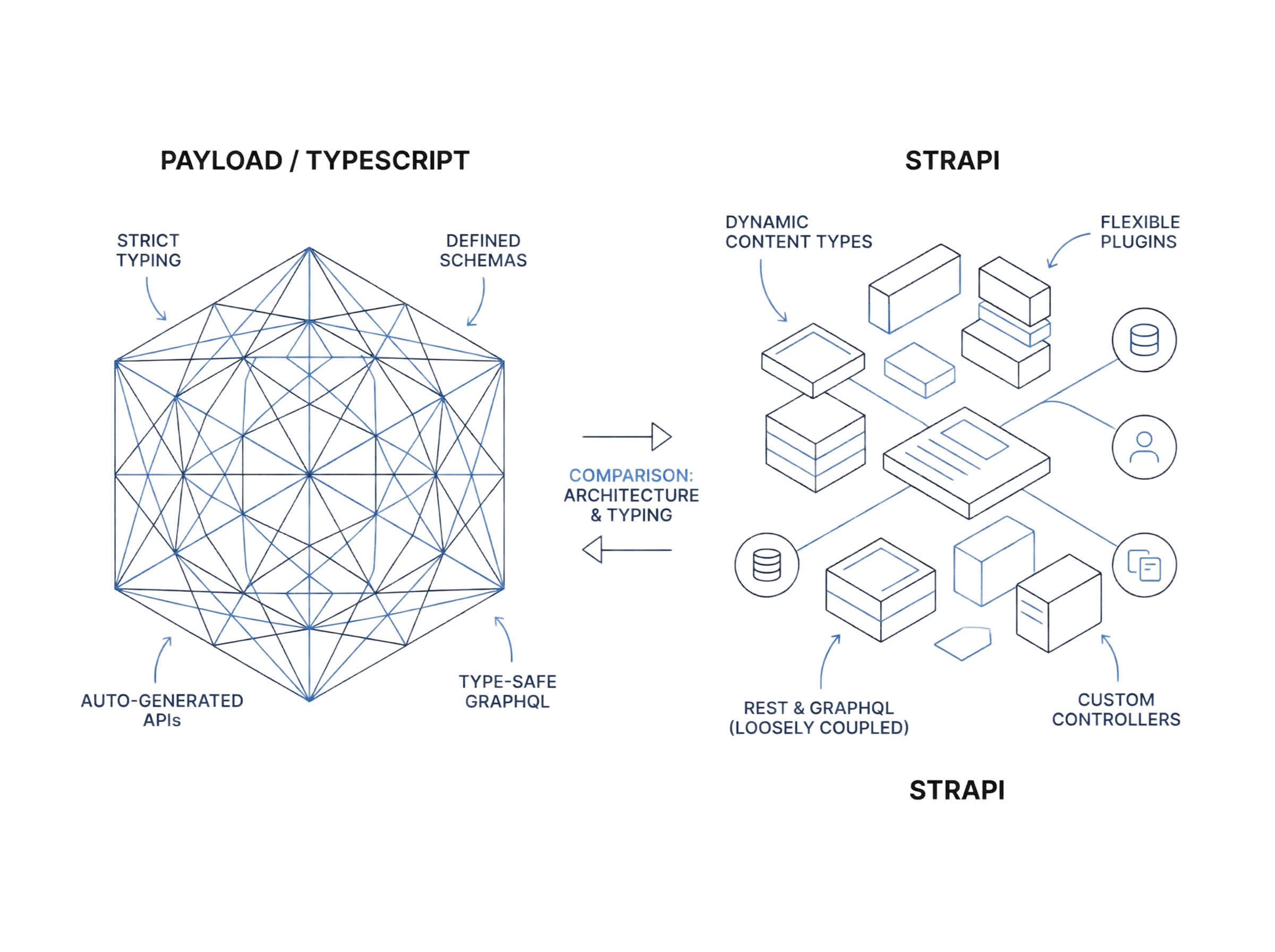
Quick Verdict
This is for you if
- You want a code-first approach where data models, access control, and the admin UI are configured natively in TypeScript.
- Your engineering team strongly prefers defining schemas in code rather than relying on visual UI builders.
- You want deep integration into modern Next.js and React server ecosystems with a rapidly moving, developer-focused release cycle.
Not a fit if
- You prefer a traditional admin UI builder that allows non-technical teams to visually create and modify content models.
- You need to leverage a massive, pre-existing ecosystem of over 400 community plugins and dozens of enterprise integrations right out of the box.
- You are looking for a highly seasoned, enterprise-established platform with a decade of market presence and broad relational database tooling.
| Feature Dimension | Payload CMS | Strapi |
|---|---|---|
| Architecture | Code-first, TypeScript-native | Traditional admin UI builder, modular |
| Platform Scope | Developer-focused CMS framework | Enterprise-focused headless CMS |
| Extensibility | Code-level hooks, custom React components | Plugin API, custom controllers & middlewares |
| Ecosystem Size | Curated official plugins, growing community | Massive library of 400+ community plugins |
| Content Modeling | Defined strictly in code configurations | Visual builder, accessible to content teams |
| Commercial Backing | Strategic acquisition by Figma | Heavily VC-funded ($41M total) |
Where Payload wins
Code-First Developer Experience
Payload embraces a paradigm where content models and access controls are defined strictly in TypeScript. This tight coupling between the schema, code structure, and the automatically generated admin UI significantly reduces friction for engineering teams building complex, logic-heavy applications that need precise programmatic control.
Modern Workflow Integration and Momentum
With a remarkably high release velocity and integration into the broader design-development ecosystem (evidenced by its Figma acquisition), Payload is aggressively pushing modern developer workflows forward. Its deep alignment with Next.js, React environments, and a comprehensive local API makes it a highly potent tool for developers over traditional API-only headless constraints.

Where Strapi wins
Visual Content Modeling Accessibility
Strapi provides a highly mature, traditional admin UI builder. This allows non-technical content teams or system administrators to visually create, modify, and manage content types without needing an engineer to touch configuration code or run a deployment for a schema change.
Massive Ecosystem and Integrations
Launched in 2015, Strapi boasts a significant head start that translates into a massive library of plugins. With over 400 community plugins, 25+ starter templates, and over 50 official integration partners (spanning search, e-commerce, and enterprise CDNs), teams using Strapi rarely have to build standard integrations from scratch.
Migration considerations
Migrating to Payload:
Teams moving from Strapi to Payload must translate UI-built content models back into TypeScript configurations. You will be shifting from a highly plugin-dependent extensibility model to a code-centric one, meaning custom endpoints, middleware, and external integrations might need to be rewritten into Payload hooks and React admin components.
Migrating to Strapi:
Moving from Payload to Strapi involves decoupling your content schema from your application codebase and managing it through Strapi's visual UI. Custom business logic, deep Next.js local API integrations, and fine-grained programmatic access controls will need to be refactored into Strapi's plugin architecture and custom controllers.
Decision Framework
The Final System Check
Choose Payload if
- Your team fundamentally prefers defining infrastructure, schemas, and logic strictly in code (TypeScript).
- You are building deeply integrated web applications requiring native server-side API access and React customization.
- You prefer a modern, rapidly iterating framework over legacy paradigms.
Choose Strapi if
- You need content models to be easily manageable via a visual UI by non-developers.
- Your project relies heavily on out-of-the-box third-party plugins, starters, and enterprise CMS integrations.
- You require the security and widespread community support of a highly mature, heavily funded ecosystem platform.